Showing posts with label Before Watchmen. Show all posts

Wednesday, May 21, 2014

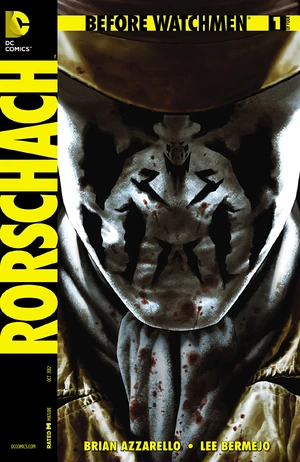
Before Watchmen: Rorschach

The final Before Watchmen Wednesday!

We wrap up our Before Watchmen coverage with a look at Brian Azzarello and Lee Bermejo’s take on the gritty, street-level Rorschach. I’ll say this; you certainly have to say that the creators managed to maintain the character tone from the original series.

In one of the better prequels in the series, this limited series has a beginning through an end, a complete narrative, something many of these Before Watchmen comics have lacked. And it covered new ground, too. The story isn’t exactly revolutionary, but this series gives us a solid look at the types of cases that Rorschach dealt with before the events of Watchmen. So basically, this book is exactly what all the BW books should have been.

I consider it high praise to say that I got a real Punisher vibe from this book. Much like Circle of Blood or Return to Big Nothing, this felt like a big, violent chapter in the vigilante career of the NYC-based Rorschach. The villains have enough character to be despicable, and Bermejo does a great job giving them unique looks so that we can recognize and cheer as each one gets taken out by the protagonist.

The story does introduce a bit of supporting cast at the Gunga Diner, and there is a subplot about a serial killer, but the main plot and driving action is Rorschach’s obsession with a certain group of pimps and drug dealers. It is clear where his focus lies.

Lee Bermejo’s artwork is stunning. I can’t overstate the gritty, grimy feel of New York City, and of the cast of characters involved. Everyone has stains, rumples, and imperfections that add both realism and sadness to the proceedings. Bermejo’s work with the ever-changing Rorschach mask is an inspiration, especially when the mask ends up on someone else. There is almost a sheer quality to the mask, something I would have though impossible to express on the drawn page. Bermejo’s fully realized cast and setting make this series possibly the most faithful to the spirit of the original Watchmen. This is the gateway comic you’d give a fan of the movie who wanted more.


Is this story at all essential to the Watchmen reading experience? No, but it reads like a few chapters of a GOOD ongoing Rorschach series that never was. That’s a perfectly acceptable approach for this type of prequel. 

Wednesday, May 14, 2014

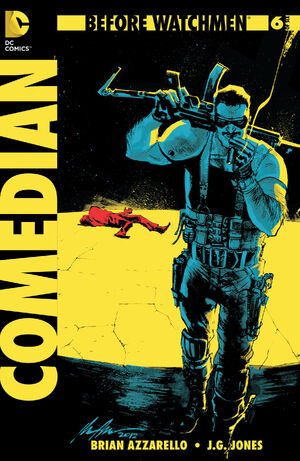
Before Watchmen: Comedian

Before Watchmen Wednesday!

Brian Azzarello’s contributions to the Before Watchmen mythos skew closer to Darwyn Cooke’s original stories than Len Wein’s well-meaning attempts to mine old ground. That said, of Azzarello’s two books, Comedian isn’t quite as compelling.

The Comedian’s story is very tied in to the time period, with the main crux of the plot involving the Kennedy’s, Viet Nam, and the politics surrounding both. I’ll admit there were a few times that I’m sure the impact would have been a bit stronger for me if I was more familiar with the players of the time period. (For example, that is G. Gordon Liddy working with Nixon, but I just don’t know enough about him to fully appreciate the interactions.)

As a back story, this doesn’t really explain why Edward Blake is the way he is. The guy is a violent monster in this too, and there is no true “origin” story to speak of. Now, Blake clearly has some sort of break while fighting for the US Government in Viet Nam, but we don’t ever see what made Blake quite this cruel.

What is interesting is that Azzarello gives us glimpses to a Comedian that understands how far gone he really is. There are quiet moments, moments between the massacres and beatings that show that Blake is capable of feeling something besides disgust and rage. When Blake and Moloch share a drink to mourn the passing of an American icon together, it is a great humanizing scene. There are enough scenes like that peppered through the collection to make it compelling.

I’m not sure I ever understood the actual narrative, though. The story doesn’t exactly have a beginning, middle, and end. Instead, this is a glimpse into the Comedian’s life during a very destructive era. It is an illuminating glimpse, but the lack of clear plot kept me from getting more immersed in the story.

J.G. Jones does a fabulous, job, as always. One thing is certain, after seeing his take on the different Comedian costumes (like the one he wears on patrol in Viet Nam); Jones has a knack for realistic portrayal of super-hero costumes. He has a gift for celebrity faces too, but I’m afraid that the constant touch points to the real world took me out of the story a bit.

This is a FAIR comic, but not required reading. I would have liked to have seen a few other Watchmen characters too, especially Silk Spectre, considering how important the two characters are to each other’s development.

Wednesday, April 30, 2014

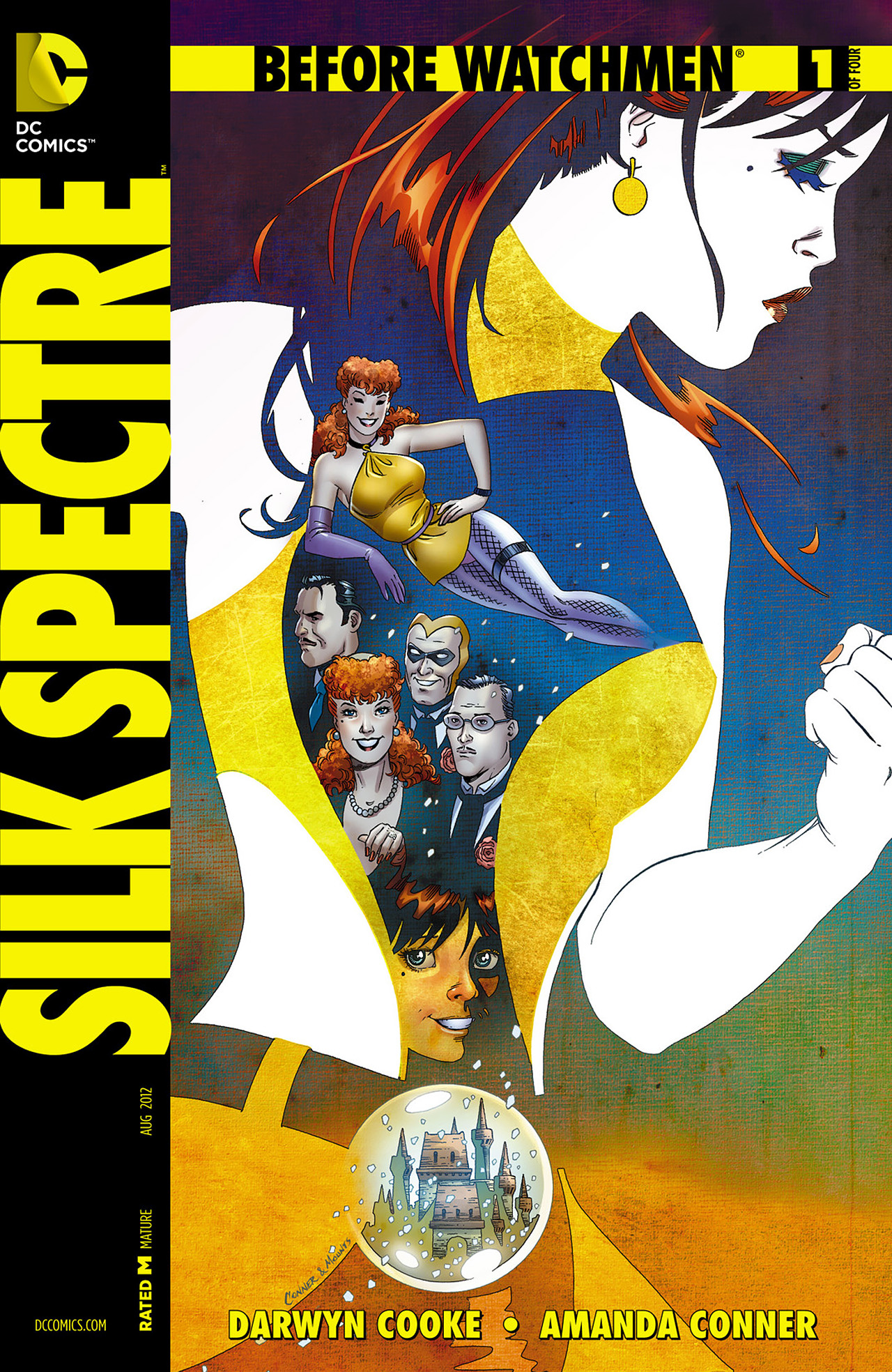
Before Watchmen: Silk Spectre

Before Watchmen Wednesday!

I really had a hard time making myself care about this comic. I’m not sure if this is because I don’t love Silk Spectre, if it is because I don’t have a lot of interest in the San Francisco counter-culture scene of the 60s, or if I never bought in to the villains and overall plot. But I never really got engaged in this limited, and even found myself skipping some pages.

Laurie Jupiter does come off like a normal girl. She has a crush on a boy, she gets mad at her mother, and wants to live her own life. Darwyn Cooke lays out a path for her that makes sense and shows the path of her becoming a woman. The problem is there aren’t enough super-heroics in it for me.

Just like in the Minutemen series, Cooke keeps the tone fairly light. Laurie’s life isn’t awful at all, and in fact the darkest parts of it come from her mother (the original Silk Spectre) and the Comedian. This is as it should be; those are tragic characters in well-established cycles of destruction. The problem is… the book is almost too light! I didn’t get wrapped up in Laurie’s problems because they just seemed to be so off-the-wall and 60’s kitschy.

Amanda Palmer does a fantastic job, as always. Her characters have different builds, especially the two Silk Spectres. The use of classic art interjected into the panels gives Laurie a “real girl” type quality that makes her very endearing. I thought the LSD sequence went on way too long, so long that I found myself skipping most of the pages. Palmer clearly spent time creating a lived-in world for Laurie. The neighborhood, friends, acquaintances, and villains of San Francisco are all tremendously lived in and real-feeling.

The problem is, I’m sort of like Hollis Mason when he makes his brief appearance. It’s not really a world I’m interested in seeing more of.

Average


Wednesday, April 23, 2014

Before Watchmen: Minutemen

Before Watchmen Wednesday!

Now THIS is what the Before Watchmen project should have been like.

I’m not sure if it is because the Minutemen were largely unmined and therefore more fertile ground, or if it is just because Darwyn Cooke is so darn good at what he does. But it is clear that this series is the high point of the Before Watchmen projects.

Unlike the others, this series takes what we already know about the Minutemen and uses those moments to springboard us into new cases, new adventures, and new interactions for the characters. Using Hollis Mason, the original Nite Owl is a brilliant move, since he’s the most heroic and straightforward of the entire team. Hollis never comes across as an idiot, but he does come across as a simple man doing his best to serve the greater good. In the pessimistic, “smart” world of the Watchmen, it is nice seeing someone who just wants to do the right thing and isn’t blind-sided by the real world. (The Nite Owl series played Dan Dreiberg as sort of a doofus shocked that people engaged in adult activities.)

Cooke’s Minutemen is a mix of sub-teams, like any good super hero comic. Captain Metropolis and Hooded Justice spend most of their time to themselves. Silk Spectre and the Comedian have their complicated relationship playing out to one side. The bulk of the pages focus on Mason’s group of guys who actually want to do some good. Silhouette, Mothman, and Nite Owl actually go out on patrol and work cases when they leave the team, unlike well-meaning doofuses like Dollar Bill.

Cooke shows remarkable restraint throughout the whole series. While it is easy to dismiss the Minutemen as corrupt, stupid, or both, Cooke plays them as a conflicted, complicated group that basically was trying to do the right thing. When Hollis talks about Dollar Bill’s fate, he tells the reader he’s not going to laugh at the joke because Bill was basically a good guy and a friend. There is no need to mock the super-hero cape trope here; that can stand in the core series itself.

Like an actual, real miniseries, there are subplots and character arcs that play out over the series. Even the most mysterious member of the team, Hooded Justice, gets some time in the spotlight, although it is filtered through the lens of Nite Owl’s suspicions. The Comedian comes across as a sociopath and Silk Spectre as a faker, but they are the least of the team. Mothman has a quiet dignity and courage that wears him down and Silhouette is a hard-ass won over by Hollis’ earnest courage and openness.

The art is delightful, of course. Cooke’s classic style works perfectly on these characters. The Comedian’s early look shows the stark contrast between his sidekick style costume and the insane tendencies he uses to motivate himself. Nite Owl’s silly pants and suit look impressive and heroic, especially in the triumphant moments that Hollis gets during the series. Each of the characters has a different build and facial structure, making it easy to recognize people both in and out of costume, always a triumph in the comic medium. I shouldn’t be surprised that Cooke is able to take a rag-tag bunch of throwaway characters and make them into something I wish I could see more from.

The bravest thing Cooke does in the series is the conclusion. We all know how the Minutemen’s story ends. We know what happens to Hollis Mason. The Watchmen is a tragedy, we get it. But Cooke decides to take a different angle when ending this series and the book is stronger for it.

I am actually going to buy this series.


GOOD

Wednesday, April 16, 2014

Before Watchmen: Ozymandias

Before Watchmen Wednesday! 

This is exactly what I feared when I started hearing about Before Watchmen. Len Wein is tremendously loyal to the source material, but that leads to an entire collection that feels like it could have been left on the cutting room floor. It feels like the reason why we never really saw all this history for Ozymandias is literally because we didn’t need to see it.

Other than a few pages where we see him traveling the world to hone his powers, Ozymandias spends this entire series setting up the actions we know he takes in the core Watchmen series. Do you want to see him clone sweet Bubastis? Do you want to see him actually hire the sci-fi writers and scientists he will use for his master plan? Would you like to watch him scout locations for his arctic base? If that type of minutia scratches an itch for you, then you will actually like this series. For me, I found the main plot to be tedious and unnecessary, which weakened the aspects of the book I did enjoy.

I found it interesting that Ozy had been engaging in pretty morally repugnant behavior for a long time. I always enjoyed him as an “ends justify the means” type of hero, but having him kill off his assistants and employees certainly moves him into clear criminal mastermind territory.

I also enjoyed seeing the repeated confrontations with the Comedian. These two are pretty evenly matched, so their fight scenes (narrated by our unreliable narrator Ozy). Wein does a nice job keeping it unclear if Comedian would actually have had any wins or not; Ozy claims he lost on purpose in pursuit of different goals, but there is no way for the reader to be sure.

Jae Lee’s atmospheric and ethereal artwork is an interesting choice for the series. I almost think he brings more mystery and gravitas to the scenes than they actually need. Lee has always excelled in strange locations and atmospheres, and there isn’t a ton of call for that here.

On the scale of Watchmen projects, this one is skippable. We already saw Ozymandias’ finest moments in the main series itself.


Average

Friday, January 24, 2014

Before Watchmen: Moloch 1-2 (2013)

Now books like this make me think that maybe, just maybe, Before Watchmen might have been a money grab. I know that all comics are there to make money, but really, who wanted a two-issue look into bit player Moloch’s past? Especially a glance into his past that doesn’t really add anything to the character’s few heartbreaking moments in Watchmen?

That’s the core problem here, out of three character focuses that I’ve read so far, only one really added anything to the character. Nite Owl benefited from more time as a main character. Dr. Manhattan and especially Moloch worked in limited doses, with the focus justifiably on their role in the greater story.

Spending these pages building up a tortured background (complete with adult scenes) for a throw-away character just seems strangely misguided, at best. Something tells me that J. Michael Straczynski wasn’t sitting around for the past 30 years pondering the best Moloch story he could tell.

The strongest part of this limited is the art from Eduardo Risso. The emotion and acting in the characters’ faces is consistently strong, although Moloch is never anything more than pathetic. If the goal was to make the heroes sort of like bullies to this deformed man, then mission accomplished.


I can recommend this one only for fans of Risso’s art. No real point in reading this for anything else. EVIL. 

Wednesday, January 22, 2014

Before Watchmen: Dr. Manhattan 1-4 (2012)

J. Michael Straczynski spends a lot of time dancing around the big events we know from the real Watchmen. More than Nite Owl, which told an older story and filled in some gaps, this series does a bit of that before rocketing into the Watchmen story we know and love. Scenes are replayed from different perspectives. Strong plot points from Watchmen are alluded to in order to play up the importance of the new story.

Basically, this is the sort of story I was worried about when I heard about Before Watchmen. If the best, most incredible parts of the story happen somewhere else, and these books just have people talking about them, or dropping hints about them? Then why not just read the original classic?

The other problem, of course, is that Dr. Manhattan is just an a$$ hole. The most interesting parts of his story come early in his life, from his heroic father and mother. Maybe when he started out, he’s an interesting 60’s era scientist. I liked reading about his early relationship with his sidekick and wife.

But my lord. When you take a fantastic concept, one that was touched on in the original Watchmen in a few pages, and drag it out into the core concept for a four issue prestige series? Aargh, it gets painful. The fact that Manhattan is experiencing all stages of his life at the same time is such a foreign, but still identifiable concept that it justifiably blows the mind of every 14 year old who reads Watchmen.

But watching the character travel up and down his own timeline to fix some vague problem? What? There is no villain here. Manhattan isn’t really working against anyone. And the closest thing we have to a villain did all of his best work in the core Watchmen series.

Adam Hughes’ art is beautiful. No surprise. He excels in the 50’s and 60’s time periods. Seeing all those scientists in their old west labs… the sense of bygone times is tremendously strong and nostalgic. Those scenes would not work half as well without Hughes selling the moment. Manhattan’s wife is radiant in the past, and her fading beauty is emphasized in the scene where the Minutemen form their first team-ups. All I could think while reading this is that Hughes would be a fantastic artist for a Barry Allen Flash series.


The worst part is the climax that shows Ozymandius’ scheme from a different perspective. That’s the danger of fluffing pages out around a core concept that can’t change. The best opportunity to read about this character is not in this series. EVIL. 

Monday, January 20, 2014

Before Watchmen: Nite Owl 1-4 (2012)

Don’t worry everyone. I didn’t actually buy any of these Before Watchmen cash-ins. No, like any good-hearted comic fan, I checked out the hardcover from my local library. I’ll be splitting these mammoth tomes up into separate reviews. Each of the collections has multiple limited series combined inside, but they are so thematically and tonally different that I think they need their own review. The first Before Watchmen product I started with is Nite Owl.

This is a good opener for me, since I was always a fan of Nite Owl. He’s basically supposed to be Blue Beetle, right? How could he go wrong? And to be honest, J. Michael Straczynski doesn’t actually ruin the character here. Dan Dreiberg has the same mix of self-doubt and confidence that made him so entertaining in the original Watchmen film. And more than any other character in the mythos, I think Nite Owl can survive having new layers of story added into his history. This guy is essentially Batman, so he can handle it, right?

I must say that I absolutely hate the characterization shortcut of having Nite Owl constantly dropping predictions about future technology. I don’t care about predicting things like the GPS, dude. It is easy to go back and give a character those types of precognizant abilities when writing a flashback. That is a trick used by bad sitcoms. It is just lazy writing.

JMS’ approach is to show the early team-up of Nite Owl and Rorschach. It’s a nice moment, and the budding friendship is entertaining when it is on-panel. It gets glossed over a tad, which is disappointing, but I can see that DC needed to spend those pages on adult content. There is a fair amount of nudity in this book, most of it gratuitous and unnecessary, but that is what makes this a Before Watchmen comic, right?

JMS plays up Dreiberg’s awkward side in his interactions with… I don’t know what to call her. Super-prostitute? I guess? Anyway, Twilight Lady wears a mask, but it seems more for her work than any actual super-heroics. The scenes do show off Nite Owl’s good heart, but they also really play up what a doofus he is.

There isn’t exactly a through-villain for the series, but an evil priest makes for a good foil for an issue or two. It does show off the strongest part of these four issues; the friendship and partnership of Rorschach and Nite Owl.

Andy Kubert’s art is solid. His father Joe’s inks give the art that nice scratchy look that makes this seem older than it really is. I never noticed anything tremendously unique, in fact, I’m not sure if Rorschach’s face mask was changing throughout the issue or not. I’m ashamed to say I didn’t notice. I do really like the design of Twilight Lady’s costume (when she wears it). Mainly, her 60’s beehive hairdo really establishes a time and place for the story.


So I don’t regret reading this, but it certainly isn’t required reading, even for Watchmen fans. If you are a Nite Owl fan, I guess this could be considered FAIR.